

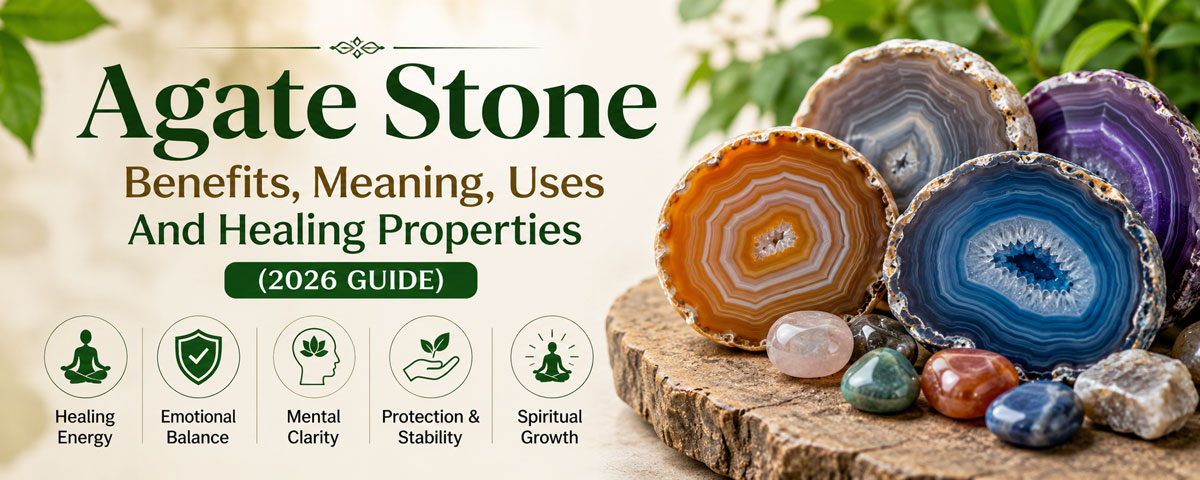
Agate has never been a stone that needs too much decoration. Cut it, polish it, and the stone usually does the talking on its own. Fine bands run through the surface. Colours shift from earthy brown and grey to red, orange, cream, and softer translucent shades. Hold a polished piece in the hand and it feels cool, smooth, and surprisingly solid.
Behind that finished surface is a much older story.
In Khambhat, Gujarat, agate work has been part of local craft knowledge for generations. The city, once widely known as Cambay, is closely associated with stone cutting and bead making. The roots of bead-working in western India stretch back to the Harappan period, when agate and carnelian were shaped into carefully worked beads and ornaments.
That history still matters in 2026. Agate is now found in jewellery, meditation spaces, crystal collections, home décor, and traditional spiritual practices. Interest in agate stone benefits and healing properties has also grown, although such beliefs should be understood as part of crystal and spiritual traditions rather than medical science.
At Agate Cambay, also associated with Sajid Gems, the stone appears in many forms. There are polished pieces, carved shapes, spiritual tools, and handcrafted gemstone products. Each form starts with the same basic material, yet the natural bands and colour variations make every finished stone slightly different.
What Is Agate Stone?
Agate is a type of chalcedony, a microcrystalline form of quartz. It generally forms when silica-rich fluids enter cavities or cracks in rock. Over a long period, mineral material settles in layers. These repeated deposits create the bands and patterns that make agate easy to recognise.
Some pieces show clean, curved lines. Others have cloudy areas, tiny colour changes, or patterns that seem almost uneven until the stone is polished. There is no standard design hidden inside every piece. Nature does not work from a product catalogue.
This individuality is easy to notice in polished tumbled stones. Tumbling smooths rough edges and gives the surface a softer finish, allowing the natural pattern and colour to become more visible.
Agate is also suitable for careful shaping and polishing. Craftspeople turn the material into agate balls, spheres and eggs, carved objects, beads, pendants, and pointed forms. The final shape may be planned, but the pattern of the stone still has a say in how the piece looks.
Khambhat’s Ancient Connection with Agate
Khambhat’s relationship with agate is much older than the recent popularity of crystals on social media. Stone bead production in this part of western India has deep historical roots connected with the Indus and Harappan craft tradition. Archaeological research has traced agate and carnelian bead-making practices in the region back thousands of years.
In 2008, the agate stonework of Khambhat received Geographical Indication recognition. The GI status formally connected the craft with its place of origin, but local artisans had already been cutting, shaping, drilling, and polishing stone long before such recognition existed.
The workshop process has its own rhythm. Grinding wheels run with a steady mechanical sound. Fine stone dust gathers around the work area. Rough pieces are examined before cutting because a careless decision can remove an attractive band or change the final appearance of the stone.
Then comes shaping and smoothing. The rough texture slowly disappears. After polishing, colours that looked dull at first can appear clearer and deeper. Run a finger across a finished piece and the surface feels completely different from the raw stone that entered the workshop.
Why Cambay Agate and Carnelian Are So Distinctive
One of the most interesting parts of Khambhat’s stone-working tradition is the treatment of agate and carnelian. Traditionally, collected stones are dried in the sun and fired to reduce moisture. Historical craft methods also involve controlled heating before the stones move through cutting and polishing stages.
Carnelian responds particularly well to careful heat treatment. Suitable material can develop stronger orange and red tones, giving the stone the warm colour for which carnelian is widely recognised. The change is not simply a coat of colour placed on the surface. Heat affects the appearance of the stone itself.
After heating, the real handwork continues. Cutting, grinding, shaping, and polishing all require judgement. A craftsperson needs to look at the rough material and decide where a line should fall or which part of a natural pattern is worth keeping.
This same attention can be seen across carved forms such as gemstone pyramids and obelisk and points. Two pieces may share the same stone type and shape, yet natural markings prevent them from looking completely identical.
Agate Stone Meaning and Traditional Symbolism
Agate has carried different meanings across cultures and periods of history. Its layered appearance has often been linked with balance, stability, and protection. Perhaps that association comes from the stone itself. Agate forms slowly, one mineral layer after another, until a solid piece develops inside the rock.
In traditional crystal practices, agate is often described as a grounding stone. People may carry it during meditation, keep it near a workspace, or place it in a room where a calmer atmosphere is preferred. These uses come from spiritual and cultural beliefs rather than established medical evidence.
Colour also plays a part in how agate is interpreted. Red and orange stones are commonly associated with energy and courage, while softer shades may be connected with calmness and emotional balance. The meaning can vary depending on the type of agate and the spiritual tradition being followed.
This is one reason agate appears in chakra sets and other crystal arrangements. Stones are often selected by colour, symbolism, and personal preference rather than appearance alone.
Agate Stone Benefits: Why People Still Use It
Search for agate stone benefits and a long list of claims usually appears. Some are rooted in old crystal traditions. Others have been repeated so often online that the original context is difficult to trace.
A more sensible way to understand agate is to look at how people actually use it.
Many crystal practitioners associate agate with emotional steadiness and grounding. A smooth stone may be held during meditation or kept nearby during quiet reflection. The physical feeling matters too. A polished stone has weight, a cool surface, and a texture that can give the hands something simple to focus on.
For this reason, worry and thumb stones are shaped to sit comfortably between the fingers. The thumb naturally moves across the smooth indentation. Some people find the repetitive movement calming, although it should not be treated as a medical treatment for stress or anxiety.
Agate is also traditionally linked with protection and inner strength. These beliefs have made the stone popular in personal jewellery and small objects carried throughout the day. A bracelet or pendant is easy to wear, which allows the stone to remain close without turning it into a formal spiritual ritual.
Those interested in wearable stones often choose bracelets and chip necklaces or handcrafted gemstone jewellery and pendants. In many cases, the attraction is a mixture of traditional meaning and simple visual appeal.
Agate Healing Properties and Crystal Beliefs
The phrase agate healing properties needs a little context. Crystal healing traditions often connect agate with emotional balance, confidence, concentration, and a sense of stability. These are traditional spiritual associations. Agate has not been proven to diagnose, cure, or prevent medical conditions.
That distinction does not make the cultural use of the stone less interesting. Crystals have been part of personal rituals, symbolic practices, and decorative traditions for a very long time. The value people attach to a stone can come from belief, memory, colour, texture, or the simple habit of using an object during a quiet moment.
In Reiki and energy-based practices, agate may be placed near the body or included with other stones. Healing sticks and massage wands are shaped for practitioners who use gemstones as part of traditional energy or wellness routines.
The shape of the tool is important from a craft perspective. A wand needs a comfortable finish. Edges must be properly smoothed, and the polished surface should feel pleasant in the hand. The natural stone still shows through, with bands and colour changes running across the finished form.
Agate for Grounding and Emotional Balance
Grounding is one of the most common ideas associated with agate. In crystal practice, the term usually describes a feeling of being present, steady, and less mentally scattered.
Some people hold a piece of agate while sitting quietly. Others keep a palmstone on a desk or bedside table. Palmstones are particularly suited to this kind of use because their rounded shape fits naturally in the hand.
There is also something very direct about focusing on a physical object. The cool surface warms slowly against the skin. Tiny bands become visible when the stone is turned towards the light. These details can become part of a personal meditation or mindfulness routine without requiring a complicated setup.
Agate in Chakra and Reiki Practices
Agate is used in some chakra and Reiki traditions, often according to its colour. Different varieties may be selected to match the symbolic colour associated with a particular chakra.
Crystal practitioners sometimes arrange several stones together rather than working with agate alone. Ready-arranged chakra stone sets are commonly used for meditation layouts, Reiki sessions, or personal spiritual collections.
Agate also appears in Jap malas, where gemstone beads are arranged into traditional prayer or meditation strands. The repeated movement from one bead to the next creates a physical rhythm during mantra recitation or quiet practice.
Again, the meaning depends heavily on personal and spiritual belief. One person may choose a mala because of the stone’s symbolism. Another may simply appreciate the weight of the beads and the natural variation running through each polished piece.
Agate for Meditation and Dowsing
Meditation is not the only spiritual setting where agate and other gemstones appear. Dowsing tools have also been made from polished stone for many years.
A gemstone pendulum usually consists of a carefully shaped stone suspended from a chain. In spiritual practice, pendulums may be used for dowsing, energy work, or personal questioning rituals. Such practices are based on spiritual belief and should not be confused with scientific testing or professional decision-making.
The quality of the shape matters. A pendulum needs a balanced form so it can hang and move freely. Facetted pendulums have cut surfaces that catch light differently from smooth polished pieces, giving the stone a sharper and more structured appearance.
For meditation, the choice is usually more personal. A polished stone, sphere, palmstone, or carved object can become a familiar part of a quiet routine. There is no single correct agate shape for meditation. Texture, weight, colour, and personal meaning often guide the choice.
How Agate Is Used in Everyday Life
Not every agate stone sits on a meditation mat or inside a crystal collection. A large part of its appeal comes from how easily the material fits into ordinary spaces and objects.
Small polished stones are often kept on desks, shelves, or bedside tables. Larger pieces may become decorative objects. Agate spheres and eggs are particularly popular as display pieces because a rounded surface allows the bands to be seen from several angles.
Then there is jewellery. Agate can be cut into beads, polished into pendants, or used as small stone chips. Natural colour variation means a finished necklace or bracelet rarely looks completely flat or uniform. The slight differences between stones are part of the appeal.
Jewellery pendants make the stone easy to wear, while bracelets and chip necklaces show how rough-looking colour variations can work together in a finished piece.
Agate is also carved into symbolic and decorative forms. Angels and skulls, geometric shapes, points, and other carvings may be selected for spiritual symbolism, display, or simply because the owner likes the craftsmanship.
The Many Shapes of Agate and Gemstone Craft
Working with stone is very different from making an object from a perfectly uniform material. The craftsperson cannot simply ignore a crack, band, or colour change. The rough piece has to be examined before the final form begins to take shape.
This becomes especially clear with geometry and Platonic stone shapes. Clean edges and balanced proportions require careful grinding. At the same time, natural bands continue across each face of the finished shape.
Pyramids, obelisks and points require similar attention. A point that appears simple at first still needs accurate shaping and a smooth polish. Turn the finished stone in the hand and the pattern may look different on every side.
Other products retain a more natural appearance. Gemstone chunks allow more of the rough character of the material to remain visible. Polished pieces show smoothness and shine; chunks make it easier to notice irregular surfaces, natural edges, and the raw structure of the stone.
Neither finish is necessarily better. The choice depends on what someone wants to see in the material.
Agate Cambay and the Craft Behind the Finished Stone
The product range associated with Agate Cambay, also known as Sajid Gems, reflects the many ways gemstones are shaped and used. The work includes tumbled stones, chakra items, Reiki tools, dowsing products, carved objects, spiritual supplies, and handcrafted gemstone jewellery.
Some pieces are small enough to carry in a pocket. Others are shaped for a specific practice. Healing sticks, gemstone wands, pendulums, malas, and chakra pieces each require a different approach during shaping and finishing.
There are also products connected with pagan, Wiccan, and symbolic practices. Rune stones, for example, are used in some forms of divination and spiritual reflection. Their use is rooted in belief and personal practice rather than scientific evidence.
Agate arrowheads show another side of stone shaping. The pointed form recalls much older stone objects, although modern gemstone arrowheads are commonly collected, displayed, or used as symbolic pieces.
The finished catalogue may look varied, but the basic challenge remains familiar: work with the stone rather than force every piece to look identical. A natural band may cross the centre of a pendant. A patch of deeper colour may appear near the tip of a point. These small differences are difficult to repeat, and there is little reason to hide them.
Why Are People Still Drawn to Agate Stones?
Part of the answer is visual. Agate is simply interesting to look at. A single stone can contain thin bands, cloudy sections, translucent edges, and sudden changes in colour.
Spiritual meaning is another reason. Traditional beliefs surrounding agate stone benefits, grounding, protection, and emotional balance continue to influence how the stone is used in meditation and crystal practices.
For others, there is no spiritual reason at all. A polished sphere looks good on a shelf. A pendant works with everyday clothing. A smooth palmstone feels pleasant to hold. Natural beauty does not always need a deeper explanation.
Modern interest in crystals has also introduced traditional stone crafts to people far beyond the places where those crafts developed. A person looking for an orgone energy product may discover carved agate. Someone searching for meditation tools may come across a gemstone mala or pendulum. The uses change, but the material remains connected to the hands that cut and polish it.
Choosing an Agate Stone
Choosing agate does not have to become complicated. Start by looking closely at the stone. Check the pattern, colour, polish, and overall shape. Natural variation is expected, so small differences between pieces should not automatically be treated as flaws.
For carrying or holding, a tumbled stone or palmstone is practical. Jewellery works better when the stone is meant to be worn regularly. Meditation and spiritual practices may involve chakra stones, malas, pendulums, or other tools depending on personal beliefs.
Decorative pieces offer more freedom. A sphere, pyramid, obelisk, egg, or natural chunk can be chosen almost entirely by appearance. The best piece is often the one that keeps drawing the eye back to a particular band or patch of colour.
Agate Stone Benefits and an Ancient Craft That Still Continues
The meaning of agate has changed across time and culture, but the stone itself continues to attract attention for familiar reasons. It is durable, naturally patterned, pleasant to polish, and capable of taking many different forms.
Traditional crystal practices associate agate stone benefits with grounding, stability, protection, and emotional balance. These ideas belong to spiritual and cultural traditions and should not replace medical advice or treatment. Outside those beliefs, agate still has clear value as jewellery, décor, a meditation object, and a material shaped by skilled hands.
Khambhat adds another layer to that story. Its long relationship with agate and carnelian connects ancient bead-making knowledge with workshops still cutting, grinding, and polishing stone today. Businesses such as Agate Cambay continue to work across traditional and modern gemstone forms, from simple polished stones to carefully shaped spiritual and decorative pieces.
Perhaps that is what makes agate difficult to reduce to a single meaning. It can be a spiritual object, a piece of jewellery, a carved shape, or simply a beautiful stone with lines formed long before a craftsperson placed it against a grinding wheel.
Frequently Asked Questions About Agate Stone
What is agate stone good for?
Agate is commonly used for jewellery, meditation, crystal collections, home décor, and traditional spiritual practices. In crystal traditions, the stone is often associated with grounding, balance, protection, and emotional steadiness. These associations are based on traditional beliefs rather than proven medical effects.
What are the main agate stone benefits?
Traditional crystal practices connect agate stone benefits with stability, concentration, confidence, and a calmer state of mind. Many people also choose agate because of its natural bands, smooth texture, and durability. The stone is widely shaped into palmstones, jewellery, meditation pieces, and decorative objects.
Does agate have healing properties?
Agate healing properties are part of crystal and spiritual traditions. Practitioners may associate the stone with emotional balance, grounding, or positive energy. However, agate has not been scientifically proven to treat or cure medical conditions and should not replace professional medical care.
Can agate be used for meditation?
Yes. Agate is often used during meditation because polished stones are comfortable to hold and visually calming. Tumbled stones, palmstones, chakra sets, and gemstone malas may all be included in personal meditation practices.
Why is Khambhat famous for agate?
Khambhat in Gujarat is known for its long stone-cutting and bead-making tradition. The wider region has historical connections with agate and carnelian bead production dating back to ancient periods. Khambhat’s agate craft received Geographical Indication recognition in 2008.
How is carnelian processed in Khambhat?
Traditional methods involve drying and carefully heating suitable stone before cutting and polishing. Controlled heating can strengthen the red and orange appearance associated with carnelian. The stone then passes through shaping, grinding, and polishing stages.
How can a natural agate stone be identified?
Natural agate often shows bands, uneven colour transitions, translucent areas, and small variations in pattern. Perfectly identical markings are uncommon. Surface polish, colour consistency, and the structure of the bands can provide useful clues, although professional gem testing is the better option when identification or authenticity is important.
Which agate product is suitable for everyday use?
The answer depends on how the stone will be used. Bracelets and chip necklaces work well for regular wear. Tumbled stones and palmstones are easy to carry, while spheres, eggs, pyramids, and natural chunks are commonly selected for display.
Are agate stones used in Reiki?
Agate and other gemstones may be included in Reiki and energy-based spiritual practices. Practitioners sometimes use polished stones, healing sticks, or gemstone wands during personal sessions. Such uses are based on spiritual beliefs and are not a substitute for medical treatment.
Where does Agate Cambay work from?
Agate Cambay, also associated with Sajid Gems, is based in Khambhat, Gujarat, India. The business works with gemstone products including tumbled stones, agate and onyx pieces, chakra items, Reiki tools, dowsing products, carvings, and handcrafted jewellery. More details about its gemstone work and background are available on the Agate Cambay About Us page.
